Well we’ve been talking about “long lining” so much lately that we thought we’d better balance it out by reminding everyone about the original meaning of the term – specifically trolling flies (yup, I said the “T” word) 🙂
Using the terms “trolling” and “fly fishing” in the same sentence is usually enough to spark a heated discussion among fly fishermen. The “purist” will insist that it has nothing to do with fly fishing but others will differ pointing out that the fly movement created by casting and retrieving is simply replaced by the motion of the boat. In our opinion, a rose by any other name would smell as sweet … the important thing is getting out there and enjoy yourself on the water!
So, without further ado, here is an excellent article on “fishing the long line”, AKA trolling flies, by Randy “Floon” Paskell. A big thanks to Randy for allowing us to share his knowledge & experiences with flyguys.net!
Trolling Flies | Fly Fishing the Long Line
[embedit snippet=”gas-auto-responsive-link-ad-minimalist”]
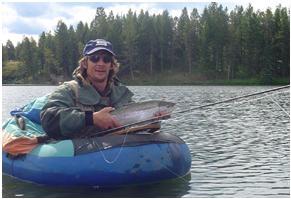
Trolling Flies & Catching Fish!
Well we’ve heard it before and we’ll hear it again: Trolling flies isn’t fly fishing. While it’s not truly in the clinical sense fly fishing, i.e.: casting and retrieving from an anchored boat, it IS an effective way to target trout in a lake.
Not only is it a good technique but at times trolling flies out produces any other method both in size and in numbers of fish!
Here’s the deal …….
How many anglers can cast their entire line consistently?? Not I.
Trolling flies is a way we as fly anglers can utilize the full potential of the longest cast and retrieve your line will allow. Positioned correctly this way of fishing can and is one of the most deadly of all fly presentations.
I’m talking about using flies, lines of different weights and fly patterns that simulate a few if not many aquatic foods to catch fish in many if not all bodies of fresh water.
Trolling Flies | Fly Lines:
 There are many types of fly lines on the market all designed to sink at different rates that enable a troller to target fish at different depths in the water column.
The ability to get and keep your fly in the fish “zone” is critical when casting and retrieving and when trolling it is no different. Keep in mind the depths listed are based on having ¾ to all the line off the spool. The following are some of the lines we use when trolling flies, and how each can be utilized to your maximum benefit … ie. catching fish!
Floating line:
This line is the ticket for anchored fishermen targeting still sitting aquatics that barely/seldom move at all. In my opinion this line is best left out of trolling because of surface disturbance when it is being pulled along. Not that it won’t catch fish, but more that big educated fish are wary of anything that is breaking the surface tension and thus can spook the more schooled guys from your offering. (Read big ones)
Type 1 line:
The type one (or slow sink fly line) is the line a troller should use in lieu of a floater as it fishes the same depth(s) as a floating line without the surface disturbance.
These lines are the most productive in the BC interior when fishing among trophy trout. This line will run in the top of the water column, from 1 to 5’ down.
Type 2 line:
This line is my go-to line in the trolling. With all the line out (70’) your bait is running about 7 to 12‘deep. This is ideal for transition areas at shoals above drop off areas. Many of these lines are clear (Stillwater, slime line) so they are great for clear water found at these vantage points.
Type 3 through 6 lines:
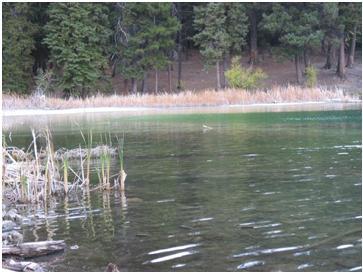 These heavier weighted fly lines are for targeting fish in deeper lies, such as the drop off areas and deep water from 14’ down to just about as deep as your line is long, depending upon the speed you are running your craft at.
A type 3 line will run from 12 to 14’ deep, a type 4, 14 to 16’ deep, while a type 6 will go down to 20’or more. Again this depends upon the speed you are traveling during your presentation.
Trolling Flies | Trolling speeds:
The biggest problem most fly fishermen have regardless whether they are casting and retrieving or trolling is that they move their offering much faster than the naturals. The best thing an angler can do is SLOW DOWN!!! If you find you are snagging up, instead of increasing your speed, a change of line to something with a slower sink rate is a much better option. The best thing that has come along in a long time for the trolling angler is the float tube because it forces you to go slower.
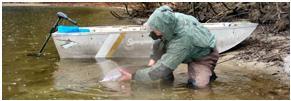 When trolling in a boat, try to match your speed with that of a tube angler. Once you have it down you can maintain it by keeping your eye on the shoreline to gauge your progress and speed of movement. After a time, you will be able to almost ignore the shore all together and use the bend in your rod blank to tell just how fast you are moving. This won’t happen right away but as you perfect your technique with practice it will become almost second nature.
When using oars, try to keep away from constantly oaring. Instead, try using short even strokes every few seconds with plenty of glide time in between. It can even be beneficial to let the craft come to a standstill before dipping the oars again.
When using an electric motor, rather than using one constant speed, use a bit higher setting and “bump” the boat along with short bursts, again maintaining the approximate speed of a tuber.
Trolling Flies | Coping with Wind:
Remember keeping your offering in the proper area is the key to your success. When faced with wind, the best thing is to use your mode of propulsion to hold not only your speed but also to keep you in, on, or around the structure you are trying to cover. You have probably heard the term quartering into the wind, well this is in fact a way to hold your position while the wind is at your back. You propelling measures are then utilized not only to move you along the water but also to hold your position off shore. If the wind is coming from the rear then “back trolling” is in order to maintain your desired position. This can be done with either oars or an electric motor. The electric can be used in reverse or even spun around 180 degrees, and the oars can be used to scull backwards. In the float tube, it becomes a little more difficult because you haven’t a reverse option. Instead try extending your legs out and pointing your flippers down to create as much drag in the water as possible.
Trolling Flies | Where to fish:
Before you jump right into the boat it might be an idea to take a second to learn a basic principle of navigation called triangulation. In fact, it’s just like it sounds making a triangle. When you eventually do get into fish, it might be prudent to be able to find where you are.
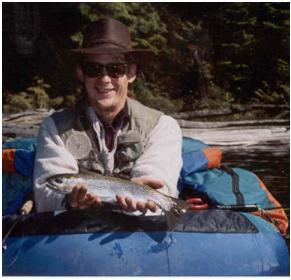 While moving your craft about the water, try marking where you are by picking 3 objects spaced roughly the same distance apart from each other around you. Make one close to where you are so you have the ability to establish some relative distance. Make note of where you are in relation to all three, and you have just made a basic triangulation.
The ideal thing to do is to find the transition area where the shoal (littoral zone) area drops into deeper water. The fish will cruise in the deeper water and move on to the shoals to feed and you want to intercept them as they make this journey. The way to identify this area is to be able to see bottom on one side of your craft and darker, deeper water on the other. If you feel the fish are deeper then change lines and move off the shallower water a bit and resume your search. This will take a bit of practice to judge just how far one should be for each line used without snagging but once you get the knack of it, the fun really begins. Of course a depth sounder is handy for this but definitely not an essential. Most lakes I fish I know the bottom depths through trial and error so well that I never use one unless I am fishing a new lake.
[embedit snippet=”gas-auto-responsive-link-ad-minimalist”]
Trolling Flies | Fly Patterns:
I have found it is best to choose patterns that are suggestive of many different trout food sources rather than exact imitations. Animated materials such a mohair, pheasant rump and marabou are great choices for lively patterns and beads and forward weight on flies are great for getting an undulating motion. Don’t forget flash and sparkle, which also simulates motion as well. Here is a short list of some of my favorite long lining patterns. There are many more to choose from, but this is just to give an idea of what to look for.
- Leech patterns
- Wooly Buggers
- Hares Ear nymphs
- Sparkle shrimp
- 52 Buick
- Carey Specials
- Doc Spratley
- Marabou Damsels
- Tom Thumb
*The venerable Tom Thumb is pretty much the only fly that I recommend trolling on a floating line. It can be and is deadly when the traveling sedges (caddis flies) are about!
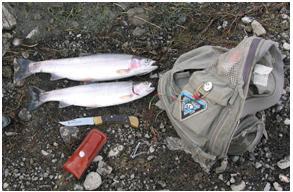 So you get the idea. Basically to be successful it is best to zero in on stuff that moves a lot in the water, and can possibly represent a lot of things in the trout diet. Add a little entomology to your arsenal and you can refine your fly choice by searching the shallows for what may be on the menu. For a real eye opener, try taking a flashlight down to the lakeshore at night and shine it into the water to see what is there…….
Nope, trolling flies is not fly fishing in the clinical sense, but it sure does put a lot of fish in the boat.
…….Randy
[embedit snippet=”gas-auto-responsive-link-ad-minimalist”]
*** for more still water fly fishing strategies please hit up & review our still water fly fishing category here!
[embedit snippet=”gas-matched-content-ti-ar”]
Like our stuff? Subscribe by  Feed or
  Email
Email .jpg)






Thanks for the article! Been doing some research to try and find out how to know more precisely the depth your flys (let’s assume unweighted flys for simplicity) will run when trolling. I have looked all over and your article gives the best idea. However, I am curious to know based upon what line you are using say at float tube trolling speed of 1mph and 100’ of line , what depth you will be fishing at? Any idea how to calculate this? Thanks
Thanks for your question Tony. Unfortunately I’m afraid there are too many variables to provide you with a formula that would give you a precise answer … ie. fly line brand, type (sink rate I, II, III, … etc.), fly (even unweighted flies are of different sizes and materials affecting sink rate), etc. In general you can start with posted sink rate of the fly line you are using and then start your troll/retrieve once you’ve counted down your desired depth. So for example if you are in 15 feet of water and you want to fish 14 feet down, and your fly line sinks at 1 inch per second, cast it out, count down 14 seconds (to get it down to 14 feet), and then start a slow troll/retrieve to keep it there. To check your accuracy if you let it sink for 8 seconds you should be hanging up on the bottom … if not then you need to keep trying till you determine just how fats your setup is actually sinking. It’s a bit of a trial and error but once you determine the sink count that works for your particular fly line/fly/trolling(retrieve) speed you will be able to repeat it. Hope that helps! Tight lines!